×

The City of The Hague hosts virtual world premiere of the new documentary film “Together We Cycle”.

On October 13, 2020, the City of The Hague hosted the (digital) world premiere of the new film “Together We Cycle”. The feature-length documentary, which is the sequel to the highly successful and critically acclaimed “Why We Cycle” explains the historical and cultural conditions that caused Dutch cities to resist the influx of cars, and make cycling the obvious choice for most citizens. It is produced by DCE participant Nieuw & Verbeterd, with whom we are partnering on distributing this important work to audiences around the world. Production has already begun on a third film, which will focus on the future of cycling.

Related posts

Civil servants from Switzerland visiting The Hague

On the 18th of October a group from Switzerland consisting of civil servants of different cities got a presentation and…

Read More

Guest Lecture University of Amsterdam

On Monday, July 4th, 2022, Dutch Cycling Embassy Marketing & Communication Manager Chris Bruntlett contributed a guest lecture to the…

Read More

Trade Mission Olympic Games Paris

As Paris is hosting the Olympic Games in 2024, lot’s of new opportunties are opening up. The organization committed to…

Read More

On October 11th the DCE joined the virtual “International Knowledge Forum” in Nepal.

DCE Director Lucas Harms gave a presentation about cycling conditions in the Netherlands, shared his thoughts on the effectiveness of cycling policies and the overall societal benefits of improving cycling conditions and answered questions from the audience, including perspectives to transfer Dutch knowledge to Nepal and the Indian subcontinent.

Related posts

Civil servants from Switzerland visiting The Hague

On the 18th of October a group from Switzerland consisting of civil servants of different cities got a presentation and…

Read More

Guest Lecture University of Amsterdam

On Monday, July 4th, 2022, Dutch Cycling Embassy Marketing & Communication Manager Chris Bruntlett contributed a guest lecture to the…

Read More

Trade Mission Olympic Games Paris

As Paris is hosting the Olympic Games in 2024, lot’s of new opportunties are opening up. The organization committed to…

Read More

Together with the Netherlands Embassy in Paris, the DCE hosted a knowledge exchange between experts from the Technical University of Delft and the French Railways SNCF.

Stakeholders from the French Railways wanted to learn from best practices in the Netherlands about the seamless integration of the Dutch bike and train system, including the elaborate provision of bike parking facilities in and around stations and the successes of the “OV-fiets” as a “last-mile solution”. The SNCF is looking forward to visit the Netherlands in 2021 and have in-depth exchanges with the Dutch Railways and ProRail as a follow-up for this first virtual meeting.

Related posts

Civil servants from Switzerland visiting The Hague

On the 18th of October a group from Switzerland consisting of civil servants of different cities got a presentation and…

Read More

Guest Lecture University of Amsterdam

On Monday, July 4th, 2022, Dutch Cycling Embassy Marketing & Communication Manager Chris Bruntlett contributed a guest lecture to the…

Read More

Trade Mission Olympic Games Paris

As Paris is hosting the Olympic Games in 2024, lot’s of new opportunties are opening up. The organization committed to…

Read More

Bas Eickhout, member of the European Parliament for GreenLeft speaks with Geert Kloppenburg and Chris Bruntlett (Dutch Cycling Embassy) about the focus of the European Union on cars, why it is hard to limit the co2-emissions of airplanes, and the role of the European Parliament by the promotion of cycling.

Related posts

Civil servants from Switzerland visiting The Hague

On the 18th of October a group from Switzerland consisting of civil servants of different cities got a presentation and…

Read More

Guest Lecture University of Amsterdam

On Monday, July 4th, 2022, Dutch Cycling Embassy Marketing & Communication Manager Chris Bruntlett contributed a guest lecture to the…

Read More

Learning to “Embrace the Bike” in London

Dutch Embassy in the UK, London Cycling Campaign and the DCE organized the webinar “Embracing the bike”. The aim of…

Read More

The following article is a contribution from Ronald Jorna and Robin Kleine as a part of their continued work with BITS EU, originally published in Dutch for MobiliteitsPlatform, and can be found here: https://digitals.acquire.nl/mobiliteit/mobiliteitsplatform-3-2020

Sustainability, health, accessibility and livability are some of the reasons we use to justify investments in bicycle policies. Cycling is a direct contributor to a better quality of life. More and better cycling infrastructure and parking facilities, higher priority at intersections and tax incentives; everything that can help us with our mission is put on the table. To do this effectively, though, information about the cyclist is essential. But how do we do so using a data-driven process?

Companies have been using data to gain a competitive advantage for a long time. Airlines create comprehensive profiles of travelers: using social media, frequent flyer programs and travel history, they advertise in a targeted way and even determine who the crew will talk to during the flight. Car manufacturers collect all kinds of data about the vehicle and its use: from fuel consumption and technical condition to driving style and preferred routes. This data is then used to improve their production process and services.

This gives these companies a strong edge, and not just with respect to each other. This is what we, as cycling professionals, are up against. Bicycle data is not only essential for improving cycling policies, it is also important for justifying and thus securing new investments. Fortunately, we see that cycling data is receiving increased attention. In addition to the fact that a big step forward has been taken with regard to counting data in the Netherlands through the Bicycle Open Data portal, we see more and more ways to collect data on cyclists.

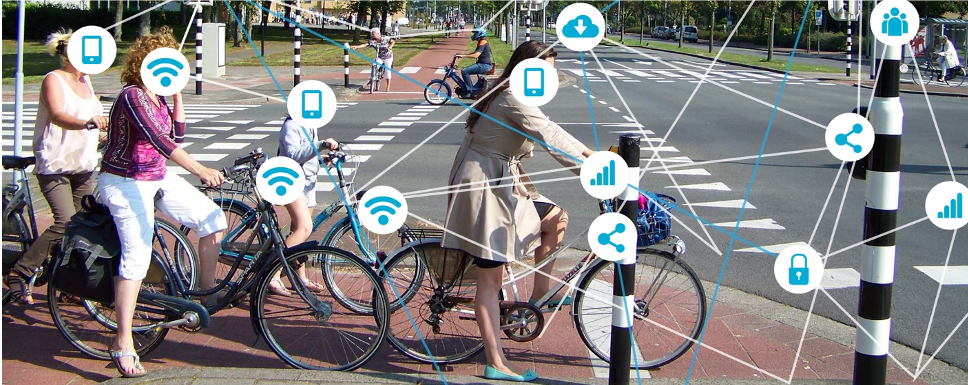
Targeted data collection is currently the most important source of bicycle data. However, the application of ITS in cycling is creating many new possible data sources. ITS provides data by definition and, if used and interpreted correctly, this data can provide valuable insights. In order to grasp these opportunities, we must first of all be aware of them and know how to make use of them. In other words, we need to train our data reflex[1].

The four steps of the data reflex are (see figure 1):

  1. Available: The data-reflex starts with seeing opportunities and ensuring that data become available. This means arranging from the start that data is collected, and that you will have access to it.
  2. Understand: You have to understand the data, both in terms of information value and how it is technically constructed: what can you do with it and what can’t you do with it?
  3. Process: Data must be processed correctly. How do you convert the data into valuable information? And how do you ensure that the data can be used by others without sacrificing privacy?
  4. Publish: The final step consists of sharing and inspiring. By sharing data and techniques we offer each other the opportunity to learn and develop new ideas.

[1] The term ‘data reflex’ was introduced in this context by Steven Soetens (Province of Antwerp) during the BITS Cycling Academy. (Antwerpen, 19 februari 2020)

 Figure 1: Data Reflex (Source: Steven Soetens, Province of Antwerp)

Figure 1: Data Reflex (Source: Steven Soetens, Province of Antwerp)

The data reflex is a central concept in the BITS project, as East Riding of Yorkshire Council also shows. East Riding is a municipality with virtually no bicycle facilities and bicycle use. The municipality wants to break through this by, among other things, introducing a bicycle library. Residents can borrow a bicycle that suits their needs: from ‘regular’ bicycles and e-bikes to all kinds of adapted bicycles. Bicycle coaches then literally help them on their way.

Now in comes the added value of the data reflex: by using different sensors in the bicycles to collect data on their use, local authorities gain insight into user behaviour and can invest more specifically in bicycle facilities. Their use is also analyzed on a personal level and the bicycle coaches use this to improve their approach. If someone suddenly stops using the bicycle, they can plan a conversation to determine what may have changed and if they can help. One data source provides the opportunity to address a multitude of elements in one swoop.

Data is often a ‘by-product’ of ITS applications. Dynamic bicycle path lighting turns on when a cyclist is detected and turns off again after they’ve passed. It’s a great application to save energy and reduce light pollution. However, every time a lamp goes on, a cyclist can be counted as well. An app that sets a traffic light for cyclists to green can, in combination with the control phasing of the traffic light, also provide insight into the number of red-light negations. Traffic experts who purchase ITS solutions for improving cycling conditions in their city should therefore not only look at the primary purpose of the ITS application (bicycle lending, lighting, reduced waiting time), but also at other data that can be collected via the ITS applications. Of course, the right agreements need to be made with the supplier (data format, ownership of the data, frequency of the data, etc.).

Don’t get us wrong, data and technology are not the solution to all problems. People have to make the right choices; people who believe that the world will be a better place if we look at mobility in a different way. Data and technology can support the creation of this better world. With data you can better respond to the behavior and needs of the target group. But this requires knowledge, expertise and a positive-critical view of technology. How is your data reflex?

Related posts

Civil servants from Switzerland visiting The Hague

On the 18th of October a group from Switzerland consisting of civil servants of different cities got a presentation and…

Read More

Guest Lecture University of Amsterdam

On Monday, July 4th, 2022, Dutch Cycling Embassy Marketing & Communication Manager Chris Bruntlett contributed a guest lecture to the…

Read More

Trade Mission Olympic Games Paris

As Paris is hosting the Olympic Games in 2024, lot’s of new opportunties are opening up. The organization committed to…

Read More