×

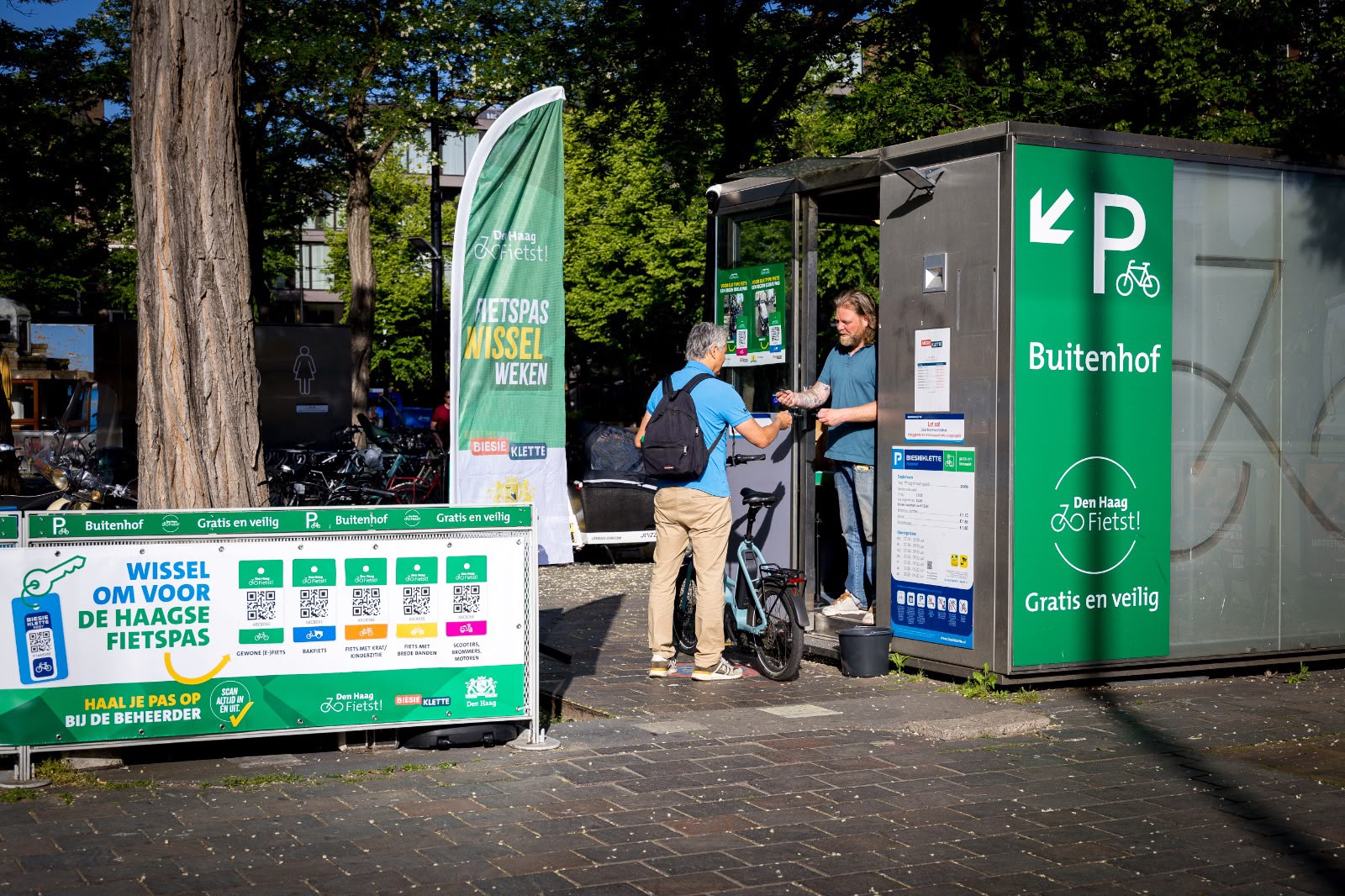
From 26 May, The Hague City Council is introducing the Fietspas (“Bike Pass”): the new access pass for all bicycle parking facilities in the city. The Fietspas replaces the familiar blue keychain. Cyclists will be able to collect their new pass from the parking facilities from that date. With this move, the council is working towards a recognisable and forward-looking system for bicycle parking.

Alderman Arjen Kapteijns (Mobility): ‘More and more residents of The Hague are taking to their bikes. We’re seeing this in our cycle parking facilities too: they’re getting busier and we’re seeing an increasing variety of bikes. The new bike pass will help us keep better track of things and use the space more efficiently. This will ensure that it remains easy for everyone to park their bikes safely, both now and in the future.’

Exchange Weeks: Switching is Easy

The Fietspas replaces the blue keychain. From Tuesday, users can collect their new pass from the bike parking facilities managed by Biesieklette. During the ‘switchover weeks’ (from 26 May to 8 June), extra support will be available to make the switch as easy as possible. Even after this period, the fietspas will remain available to anyone visiting a bike parking facility.

Five Colours for Different Types of Bikes

The number of bicycles and different types of bicycles in the city is growing rapidly. That is why five different bike passes are being introduced, each with its own colour. The colour indicates the type of bicycle or vehicle the pass is intended for. This helps to keep the cycle racks organised and to allocate the available space fairly. The process of scanning in and out remains the same. Scanning remains anonymous and parking in the cycle racks remains free for the first 24 hours. The five colours will also feature in the signage in the parking facilities by the end of this year. This will make it easy for visitors to see which type of bicycle can be parked there.

Ready for the Future

With the Fietspas, The Hague is taking a step towards a modern and flexible system. During a pilot year, the council is testing various applications of the Fietspas. For example, it is investigating whether positive behaviour among cycle park users can be encouraged through a reward scheme in collaboration with local businesses and sports clubs. The council aims to use this to encourage people to make more use of cycle parks rather than parking on the street. In addition, the council is exploring the possibility of communicating anonymously with bike pass users. This could, for example, be used to share practical information or provide tips on (cycling) road safety.

More information (in Dutch):

Photo Credit: Valerie Kuypers
Related posts

DCE joins Webinar “Ciclovias & COVID”

This week, Ana Alanis spoke in name of the DCE at the Webinar “Ciclovias & COVID”. On World Bicycle Day, the Dutch…

Read More

WRLDCTY Festival “Going Dutch” Session

Dutch Cycling Embassy hosts “Going Dutch” panel discussion during inaugural WRLDCTY Festival. Taking place from October 22 to 24, 2020,…

Read More

ThinkBike Workshop Dubai, United Arab Emirates

From February 18–19, the Dutch Cycling Embassy (DCE) traveled to the United Arab Emirates to host a ThinkBike Workshop for…

Read More

The Dutch Cycling Embassy welcomed a group of German exchange students visiting St. Bonifatiuscollege in Utrecht today for an introduction to the Dutch approach to cycling.

As part of the school’s longstanding exchange activities with partner schools in Germany, the students attended a half-hour guest lecture delivered by International Relations Manager Chris Bruntlett. The presentation explored the history of cycling in the Netherlands, the policy decisions that shaped today’s extensive bicycle network, and the many social, economic, and environmental benefits of active mobility.

Following the presentation, the students set off on a self-guided cycling tour through Utrecht curated by the Dutch Cycling Embassy. The route highlighted key examples of the city’s cycling infrastructure and public space transformations, allowing the students to experience firsthand why Utrecht is widely regarded as one of the world’s leading cycling cities.

The visit formed part of St. Bonifatiuscollege’s active German exchange programme, which has connected students across borders for many years through cultural and educational activities.

Located in Utrecht, St. Bonifatiuscollege is a UNESCO-affiliated secondary school known for its international outlook and emphasis on intercultural learning and global citizenship.

Related posts

DCE joins Webinar “Ciclovias & COVID”

This week, Ana Alanis spoke in name of the DCE at the Webinar “Ciclovias & COVID”. On World Bicycle Day, the Dutch…

Read More

WRLDCTY Festival “Going Dutch” Session

Dutch Cycling Embassy hosts “Going Dutch” panel discussion during inaugural WRLDCTY Festival. Taking place from October 22 to 24, 2020,…

Read More

ThinkBike Workshop Dubai, United Arab Emirates

From February 18–19, the Dutch Cycling Embassy (DCE) traveled to the United Arab Emirates to host a ThinkBike Workshop for…

Read More

A diverse delegation from Atlanta, Georgia (USA) visited the Netherlands last week for a Sustainable Urban Development tour, focused on cycling, micromobility and urban mobility. The visit was organised by Micromobility Atlanta and brought together a mixed group of participants, including staff from the Mayor’s Office, city council members, regional directors, and representatives from companies active in the micromobility sector.

The purpose of the visit was to gain inspiration and knowledge from Dutch cycling practice, while also exploring opportunities for collaboration and identifying potential approaches to support cycling development in Atlanta and the wider state of Georgia.

The programme was hosted by the Dutch Cycling Embassy and included a self-guided study tour in Utrecht, presentations at the Dutch Cycling Embassy office, and an informal cycling tour in Delft.

The knowledge programme featured presentations by Jeska de Ruiter (Dutch Cycling Embassy), who introduced the Netherlands as a cycling country and outlined its historical development and key policy frameworks; Johan Diepens (Mobycon), who presented on the Dutch CROW bicycle traffic design manual and the role of national design standards in ensuring safe and high-quality cycling infrastructure; and Karlijn Bruijs (Municipality of Utrecht), who shared insights into Utrecht’s approach to shared bicycle systems and their integration within the city’s wider mobility strategy. The sessions were characterised by active exchange and engagement, with particular interest in different forms of cycling infrastructure, including cargo bikes.

Related posts

DCE joins Webinar “Ciclovias & COVID”

This week, Ana Alanis spoke in name of the DCE at the Webinar “Ciclovias & COVID”. On World Bicycle Day, the Dutch…

Read More

WRLDCTY Festival “Going Dutch” Session

Dutch Cycling Embassy hosts “Going Dutch” panel discussion during inaugural WRLDCTY Festival. Taking place from October 22 to 24, 2020,…

Read More

ThinkBike Workshop Dubai, United Arab Emirates

From February 18–19, the Dutch Cycling Embassy (DCE) traveled to the United Arab Emirates to host a ThinkBike Workshop for…

Read More

The Dutch Cycling Embassy was honoured to welcome a group from the Chartered Institution of Highways and Transportation of Northern Ireland for a Study Visit to Utrecht on May 13th. As well as an informal exchange, focusses on the Netherlands cycling paradise as well as waterland, on the afternoon of the 12th, supported by Rick Lindeman of Rijkswaterstaat.

On the 13th, joined by expert Erik Tetteroo, founder of HOD works, the group spent the morning learning from his extensive expertise. Through his presentation on cycling in the Netherlands with a special focus on the transit-bike combination and an interactive quiz on cycling, there was plenty of space for interaction and exchange.

In good DCE fashion, the presentation continued with a cycling tour of Utrecht led by Erik after a delicious lunch at The Greenhouse. In a couple hours the delegation got the chance to see several parts of the city and experience Dutch cycling culture firsthand. Highlights from the tour included visiting the Stationsplein bicycle parking facility whose capacity reaches 12,500 bikes, the busy Vredenburg cycling junction, the Maliebaan and the Oosterspoorbaan cycling path. We thank everyone for their participation and keen engagement and look forward to more fruitful exchanges!

Would you like to experience Dutch cycling culture first-hand?
Get in touch with us to organise your own study visit. We would be delighted to welcome you.

Related posts

DCE joins Webinar “Ciclovias & COVID”

This week, Ana Alanis spoke in name of the DCE at the Webinar “Ciclovias & COVID”. On World Bicycle Day, the Dutch…

Read More

WRLDCTY Festival “Going Dutch” Session

Dutch Cycling Embassy hosts “Going Dutch” panel discussion during inaugural WRLDCTY Festival. Taking place from October 22 to 24, 2020,…

Read More

ThinkBike Workshop Dubai, United Arab Emirates

From February 18–19, the Dutch Cycling Embassy (DCE) traveled to the United Arab Emirates to host a ThinkBike Workshop for…

Read More

The PolyMonde program from Polytechnique Montréal visited Utrecht this week for an immersive study visit hosted by Dutch Cycling Embassy, giving 25 students and staff firsthand insight into the Dutch approach to sustainable urban mobility.

PolyMonde is a long-running student-led industrial mission that brings together future engineers to study international best practices across key sectors. The 2026 mission focuses on resilient territories and cities, industrial automation, and advanced chemistry and innovative materials, with Belgium and the Netherlands selected for their global leadership in sustainable urban development and mobility innovation.

The Utrecht program began with a guided cycling tour through the city centre, where participants experienced the Dutch cycling network from the saddle. Led by International Relations Manager Chris Bruntlett, the tour highlighted how Utrecht has integrated high-quality cycling infrastructure with public transport, compact urban planning, and people-centred street design to create a safe and accessible mobility system for all ages and abilities.

Following the tour, the group gathered for lunch at the Dutch Cycling Embassy, creating an opportunity for informal discussion and exchange between the visiting delegation.

The afternoon continued with a series of presentations exploring the policies, planning principles, and long-term investments that have shaped the Netherlands into a global leader in cycling. Discussions covered topics such as network design, governance, traffic safety, behaviour change, and the economic and social benefits of active mobility.

For many participants, the visit provided a valuable opportunity to connect engineering, urbanism, and sustainability in a real-world context. By experiencing Utrecht’s cycling culture firsthand, the PolyMonde delegation gained practical insights into how resilient and liveable cities can be designed around people rather than cars.

Related posts

DCE joins Webinar “Ciclovias & COVID”

This week, Ana Alanis spoke in name of the DCE at the Webinar “Ciclovias & COVID”. On World Bicycle Day, the Dutch…

Read More

WRLDCTY Festival “Going Dutch” Session

Dutch Cycling Embassy hosts “Going Dutch” panel discussion during inaugural WRLDCTY Festival. Taking place from October 22 to 24, 2020,…

Read More

ThinkBike Workshop Dubai, United Arab Emirates

From February 18–19, the Dutch Cycling Embassy (DCE) traveled to the United Arab Emirates to host a ThinkBike Workshop for…

Read More

On 11 and 12 May 2026, the Dutch Cycling Embassy welcomed a group of changemakers from across the United Kingdom for a study visit to the Netherlands, exploring how Dutch cities transformed themselves into cycle-friendly environments over the past decades. Which challenges were overcome and how political viewpoints changed over the years.

The delegation brought together participants from a wide range of organisations and advocacy groups, all working toward safer, healthier, and more liveable streets in the United Kingdom. Among the participants were representatives from the London Cycling Campaign, Cyclox from Oxford, Action Vision Zero, and the Coalition for Healthy Streets and Active Travel in Oxfordshire.

By bringing their own bicycles, participants were able to experience Dutch cycling culture and infrastructure first-hand throughout the visit.

Exploring Delft by bicycle

On the first day of the visit, participants explored the city of Delft during a cycling tour guided by our own, local inhabitant, Chris Bruntlett. Cycling through the city together highlighted how Delft’s cycling infrastructure connects neighbourhoods, public spaces, and daily destinations in a safe and intuitive way.

Learning from Utrecht’s transformation

The programme, organised by the Dutch Cycling Embassy and guided by Shelley Bontje and Wiel Wijnen, continued in Utrecht with a presentation by Herbert Tiemens from the Municipality of Utrecht.

Herbert shared the story of Utrecht’s transformation from a car-oriented city in the 1970s and 1980s into one of the world’s leading cycling cities today. As Senior Policy Advisor, he reflected on the long-term vision, policy decisions, and gradual changes that helped shape Utrecht’s mobility culture over time.

Participants engaged in lively discussions on topics such as balancing cycling infrastructure with emergency services, connecting wider urban areas through safe cycling networks, and the effects of reducing car parking on local businesses.

|

Exchange and collaboration

The visit concluded at the office of the Dutch Cycling Embassy, where Eva Groeneveld shared the story of the upcoming and current work of the Dutch Cycling Union (Fietsersbond) where she currently works as a Strategic Policy Advisor. Her perspective as someone who recently moved from the United Kingdom to the Netherlands also was a great add-on.

Together, we discussed the historical success of the Dutch cycling movement, current mobility challenges in both countries, and the importance of international exchange and collaboration. The conversations showed that while contexts may differ, many of the challenges and ambitions are shared.

We would like to extend a special thank you to Herbert Tiemen and the Municipality of Utrecht for sharing their knowledge and experiences with the group. We would also like to warmly thank Eva Groeneveld for her valuable support and contribution to the programme.

Related posts

DCE joins Webinar “Ciclovias & COVID”

This week, Ana Alanis spoke in name of the DCE at the Webinar “Ciclovias & COVID”. On World Bicycle Day, the Dutch…

Read More

WRLDCTY Festival “Going Dutch” Session

Dutch Cycling Embassy hosts “Going Dutch” panel discussion during inaugural WRLDCTY Festival. Taking place from October 22 to 24, 2020,…

Read More

ThinkBike Workshop Dubai, United Arab Emirates

From February 18–19, the Dutch Cycling Embassy (DCE) traveled to the United Arab Emirates to host a ThinkBike Workshop for…

Read More

Skadi Tirpak, Director of the Dutch Cycling Embassy, attended the 2026 ITF Summit in Leipzig to exchange ideas, strengthen international connections and explore how cycling can contribute to more resilient transport systems.

The Summit focused on funding resilient transport. Across the sessions, resilience was discussed broadly: not only as stronger infrastructure, but also as flexibility, governance, digital reliability, accessibility and quality of life.

One reflection that stood out was the difference in lifespan between physical infrastructure and digital systems. Roads, bridges and railways can last for generations, while digital systems can change within weeks. This raised an important question for transport planning: are our systems not only strong enough, but also flexible enough to adapt when conditions change?

Several sessions underlined the need to move beyond a narrow view of transport. Accessibility, proximity and well-being were recurring themes. Transport can help create an “active society by default”, supporting both physical and mental health, particularly in ageing societies. Carlos Moreno captured this clearly during the closing plenary: proximity is resilience.

The UN Decade of Sustainable Transport 2026–2035 was also introduced as an important framework for the years ahead. From a Dutch perspective, and presented by the Netherlands Ministry of Infrastructure and Water Management at the Summit – the integrated approach remains highly relevant. Mobility cannot be separated from spatial planning, housing, health, climate and public services. Access should be the central goal.

The Summit ended with a bicycle tour through Leipzig, offering a practical view of the city’s green structure, floodplain landscape, waterways and cycling routes. It was a fitting reminder that resilient transport is not only about finance and infrastructure. It is also about public space, everyday accessibility, green networks and the quality of urban life.

It also reinforced a simple but important closing message: cycling is not a side topic in resilient transport systems. It is part of how cities and regions can become more accessible, healthier and better prepared for the future.

Related posts

DCE joins Webinar “Ciclovias & COVID”

This week, Ana Alanis spoke in name of the DCE at the Webinar “Ciclovias & COVID”. On World Bicycle Day, the Dutch…

Read More

WRLDCTY Festival “Going Dutch” Session

Dutch Cycling Embassy hosts “Going Dutch” panel discussion during inaugural WRLDCTY Festival. Taking place from October 22 to 24, 2020,…

Read More

ThinkBike Workshop Dubai, United Arab Emirates

From February 18–19, the Dutch Cycling Embassy (DCE) traveled to the United Arab Emirates to host a ThinkBike Workshop for…

Read More

On April 20th-21, the DCE hosted a Study Visit from the US-American Georgia Institute of Transportation Engineers (GAITE). The group, consisting of transportation planners and engineers from Atlanta, Kentucky and North Carolina, spent the first two days of their week-long stay in the Netherlands with the DCE learning from Dutch cycling expertise — on two wheels, of course.

We kicked off our first day with a visit to Houten — an exemplary case of Dutch cycling in a highly planned low-traffic urban context. In Houten, the group got to learn from Arjen de Boer, Traffic Policy Officer at the Municipality of Houten about the story of Houten and how it grew from a small village to a large satellite town in response to the challenges of increased urbanisation in the post-war period. The presentations given by Nils Bruinsma (Arcadis) on retrofitting and network planning and Anne Abbing (Goudappel) highlighting the Dutch approach to traffic-calming and car management, proved very insightful, particularly later during our tour through Houten. From the venue in the historic centre of Houten, we started the tour guided by Arjen and Nils’ expertise, grounding the knowledge gained during the presentation into practice, eventually heading back up to Utrecht at the end of the day.

On our second and sunnier day, we were lucky to be hosted at the centrally-located Arcadis office in Rotterdam. There, we were joined by Maurits Lopes Cardozo (Bike-minded), who presented on infrastructure and intersection design, as well as by Lior Steinberg (Humankind) whose focus lay in quick wins and temporary to permanent solutions. After a short lunch, Lior guided the group around Rotterdam, with one participant sitting in his famous bakfiets, as he showcased cycling-centred planning in a city reconstructed for the automobile – something certainly relevant for a group coming from the US. Cycling with higher volumes of cycling traffic, alongside, but separate to motorised traffic, gave the group a sense of what cycling infrastructure can look like in urban environments with plenty of car-traffic. After the tour, we regrouped at the office to reflect on the many lessons learnt and to recap the past days. We thank everyone from GAITE for showing up fully and all the enthusiasm and expertise they showed.

We also want to extend our thanks to our experts Arjen, Nils, Anne, Lior and Maurits, without whom this visit wouldn’t be possible.

Would you like to experience Dutch cycling culture first-hand?

Get in touch with us  to organise your own study visit.

We’d be delighted to welcome you.

Related posts

DCE joins Webinar “Ciclovias & COVID”

This week, Ana Alanis spoke in name of the DCE at the Webinar “Ciclovias & COVID”. On World Bicycle Day, the Dutch…

Read More

WRLDCTY Festival “Going Dutch” Session

Dutch Cycling Embassy hosts “Going Dutch” panel discussion during inaugural WRLDCTY Festival. Taking place from October 22 to 24, 2020,…

Read More

ThinkBike Workshop Dubai, United Arab Emirates

From February 18–19, the Dutch Cycling Embassy (DCE) traveled to the United Arab Emirates to host a ThinkBike Workshop for…

Read More