×

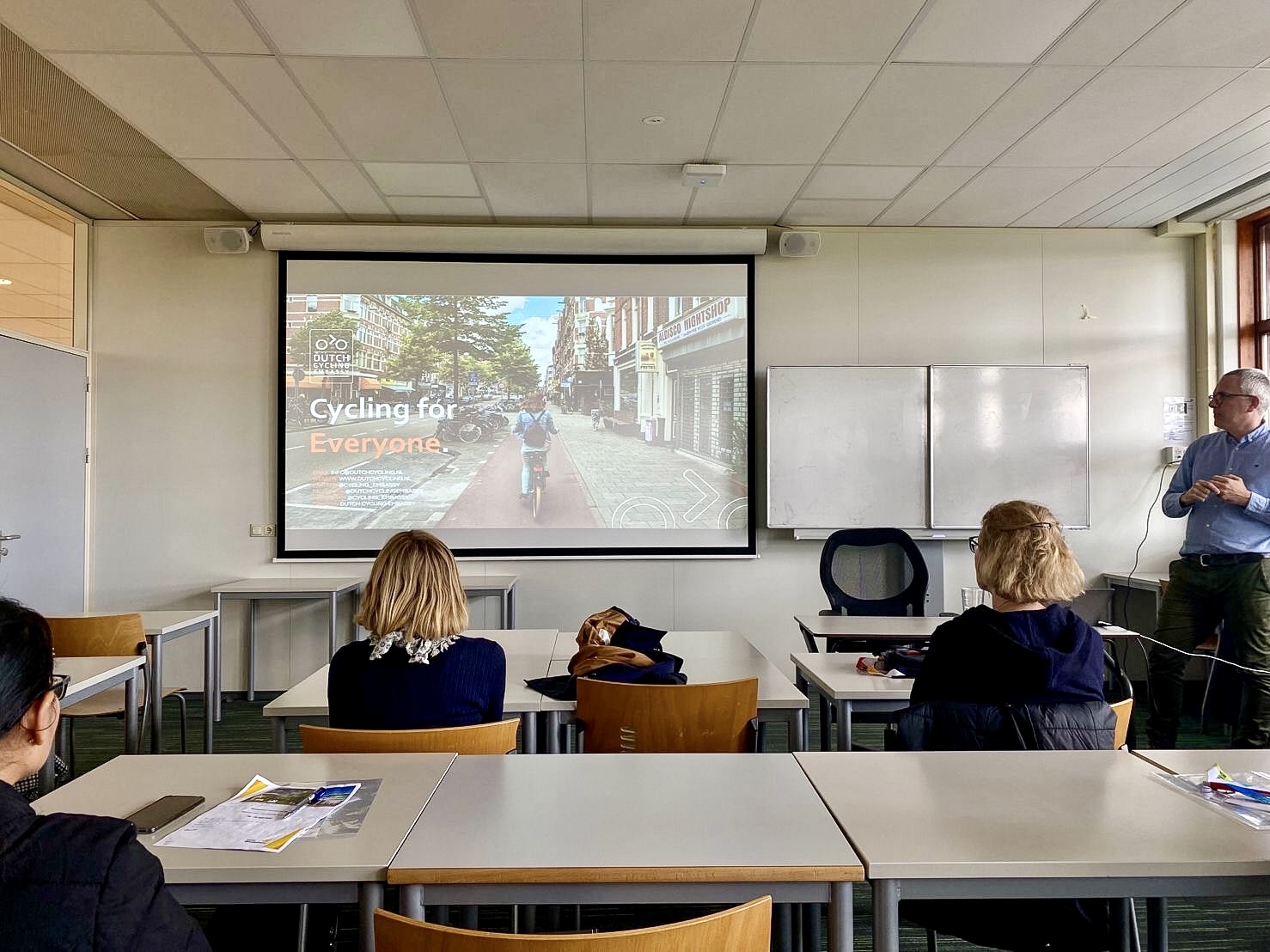
On September 25th, 2023, the Dutch Cycling Embassy’s Chris Bruntlett contributed a guest lecture to the Windesheim Hogeschool in Zwolle, as part of their “Future Cities” program. To an enthusiastic group of 40 international and domestic students, Chris outlined the history of cycling in the Netherlands and its influence on urban and transport planning. He also showed examples from all over the world where cycling is changing people’s lives in the urban environment. His 45-minute talk was followed by a lengthy and engaging discussion with the attendees. We would like to thank Windesheim for this great opportunity to share our knowledge and expertise!

Related posts

DCE joins Webinar “Ciclovias & COVID”

This week, Ana Alanis spoke in name of the DCE at the Webinar “Ciclovias & COVID”. On World Bicycle Day, the Dutch…

Read More

WRLDCTY Festival “Going Dutch” Session

Dutch Cycling Embassy hosts “Going Dutch” panel discussion during inaugural WRLDCTY Festival. Taking place from October 22 to 24, 2020,…

Read More

ThinkBike Workshop Dubai, United Arab Emirates

From February 18–19, the Dutch Cycling Embassy (DCE) traveled to the United Arab Emirates to host a ThinkBike Workshop for…

Read More

France will spend €2 billion on cycling in the coming four years.

On Friday 22nd September 2023, the DCE, together with the Netherlands Embassy in Paris, the Netherlands Business Support Office in Lyon, and the Netherlands France Chamber of Commerce held a webinar on essential factors for success in the French market. The presenters were joined by Bart Vos of Holland Bikes, who gave advice based on his twenty years of experience in France.

The webinar covered topics such as:

  • Entering the French market for the first time: why and how? Tenders, local partners, NBSO help, etc.
  • Relevant current developments in mobility, business, culture and politics
  • Lessons learnt from successful Dutch companies in France
  • How to set yourself up for long-term success in the market
  • Navigating cultural differences
  • Upcoming events in France

Attendees also had ample opportunities to ask their questions to the panel of experts, and received follow-up information after the event.

A recording is available: contact us to access it.

With many thanks to Joris Houtman, Lise Lotte Pel, Anouk Zoet and Bart Vos.

Related posts

DCE joins Webinar “Ciclovias & COVID”

This week, Ana Alanis spoke in name of the DCE at the Webinar “Ciclovias & COVID”. On World Bicycle Day, the Dutch…

Read More

WRLDCTY Festival “Going Dutch” Session

Dutch Cycling Embassy hosts “Going Dutch” panel discussion during inaugural WRLDCTY Festival. Taking place from October 22 to 24, 2020,…

Read More

ThinkBike Workshop Dubai, United Arab Emirates

From February 18–19, the Dutch Cycling Embassy (DCE) traveled to the United Arab Emirates to host a ThinkBike Workshop for…

Read More

As part of the European Mobility Week 2023, and following previous exchanges, a delegation from the Dutch Cycling Embassy visited Latvia. The delegation represented the software, orgware and hardware approach in person by the following representatives: Pepijn Verpaalen (Manager Better Biking, City of Amsterdam), Fjodor Molenaar (Official Commissioner for Traffic and Public Space, City of Amsterdam), Erik Klok (Senior Advisor Mobility and Energy, Roelofs), Shelley Bontje (Project Manager, Dutch Cycling Embassy). This mixture of representatives aligned well with the pre-discussed challenges and opportunities for cycling in Latvia. 

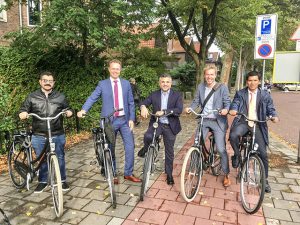
The first day began with a brief bicycle tour in the city centre of Riga, supported by Riga’s City Council staff. This provided the Dutch delegation the chance to gain insights about the current state of cycling in Riga before diving into the content. Riga is the capital of Latvia and by far the biggest urban agglomeration. The city has many plans, strategies and initiatives written out on paper concerning cycling. However, implementing these plans in practice has proven to be quite complex. 

In the afternoon, Inese Anderson, head of Riga City Council City Development Committee, welcomed the delegation at the City Counci. The day was concluded at the residence of Ambassador Pieterse, Ambassador of the Netherlands to Latvia, where the delegation among others met with Viesturs Silenieks chairman of the board of Lativa’s Cyclist Union.  

On the second day, the delegation travelled to the City of Liepaja. Liepaja is the third-largest city of Latvia and with a population of 70.000 citizens. Liepaja is compact, situated along the sea, and well-suited for active transportation. The city has been investing in cycling infrastructure and bicycle parking availability over the past decades. However, there are still areas for improvement, such as separating the bicycle network from the car network and increasing bicycle usage. Liepaja, like Riga, is part of the European Union’s 100 CO2 neutral cities program. 

Here the day started with a warm welcome by city officials from the city of Liepaja joint by city officials from the city of Kuldīga. After a presentation of the City of Liepaja about their ambitions to become climate neutral in 2023, an in-depth discussion followed including topics such as: Vision zero and how to change mind sets. The City of Amsterdam illustratively shared their insights about the Weesperstraat experiment early this summer. The in-depth discussion was followed by an informative bicycle tour throughout Liepaja including a visit to the sea front, newly opened bicycle facilities in neighbourhoods and connecting routes as well as a stop at a secondary school. Throughout the bicycle tour concrete tips, insights, and suggestions for potential improvement on the bicycle infrastructure as well as bicycle promotion programs where shared. In the afternoon the Dutch delegation joined the Seminar on Climate Change and Mobility offered by Green Tech Cluster of Liepaja in collaboration with Liepaja City and Embassy of the Netherlands in Latvia.   

On the final day, the delegation continued discussions with representatives from the City Council of Riga. The city representatives shared their ambitious plans for the coming years, including the opening of a new bicycle parking facility in the autumn, while also acknowledging challenges related to bicycle parking in some residential areas.

As the cherry on the pie the delegation went on another bicycle route, which included stops at recently redesigned plaza’s, junctions, ongoing re-developments as well as a project which had to be changed back partly due to citizens and political resistance. Throughout the day various perspectives, ideas and potential solutions for currents and perhaps upcoming challenges where shared among and by all representatives present. 

The day was concluded with a panel discussion on the development of cycling, cycling culture and safety at the Riga Technical University. Hosted by the Faculty of Architecture. Various Latvian experts, including architecture pro-deacon Beãta Dambīte Sndra Treija, Mãris Jonovs, head of the association Drošas ielas (Safe streets) and Inese Andersone, Head of Riga City Deveopment Committee, joint the Dutch delegation for the panel (virtual and inperson) discussion.

For this visit, the Dutch Cycling Embassy delegation is kindly supported by the Dutch Embassy based in Riga. We are grateful of the hard-working support of the Embassies’ team, in specific Indra Freiberga and ambassador Pieterse. As well, we truly appreciate the warm welcome which we received by the Riga City Council and Liepaja City Council and admire the great steps which are and have been taken, the drive to change is motivating!  

Related posts

DCE joins Webinar “Ciclovias & COVID”

This week, Ana Alanis spoke in name of the DCE at the Webinar “Ciclovias & COVID”. On World Bicycle Day, the Dutch…

Read More

WRLDCTY Festival “Going Dutch” Session

Dutch Cycling Embassy hosts “Going Dutch” panel discussion during inaugural WRLDCTY Festival. Taking place from October 22 to 24, 2020,…

Read More

ThinkBike Workshop Dubai, United Arab Emirates

From February 18–19, the Dutch Cycling Embassy (DCE) traveled to the United Arab Emirates to host a ThinkBike Workshop for…

Read More

The Dutch Cycling Embassy (DCE) had the pleasure of interviewing Rein Aarts from Breikers to gain insights into their experience with the Dutch tool ‘MobilityAnalyst,‘ developed by MobilityLabel.

DCE: Can you begin by introducing Breikers? 

Rein Aarts: I work for an organization called ‘Breikers,’ which is a foundation. We were established in 2015 by two employers’ organizations in the Amsterdam region with the goal of assisting large employers in adopting more sustainable travel practices. Subsequently, a government program named ‘Beter Benutten,’ which can be translated to ‘used more efficiently’ in English, was introduced. The aim was to use our infrastructure more efficiently, because what you see is we’re investing large amounts of money in infrastructure which we use in a very silly manner. In a traffic jam we’re all stuck, and during the rest of the day there’s plenty of space. The idea was to take a little bit of this investment in heavy infrastructure and use it not for heavy infrastructure, but for changing behavior in the way we use this infrastructure. 

These two employers’ organizations founded ‘Breikers’ to help employers embrace smarter commuting options for their employees. Since then, we have assisted 400 large employers with our advisory services. Our product primarily consists of advice. We engage commercial consultants from the market to assist employers in promoting more sustainable travel. In a sense, we function as a consultancy firm, although we operate in a rather unconventional manner, as we do not send invoices. The consultants work for us and submit their bills to us. We are funded by the Dutch government because we contribute to achieving public goals, such as reducing congestion and emissions through sustainable transportations options like public transport, car sharing, mobility as a service and cycling.

DCE: How does Breikers use MobilityAnalyst? 

Rein Aarts: We aim to encourage people to be more active, and this is where the MobilityAnalyst comes into play. In our consultancy work, we conduct a comprehensive analysis of people’s current travel patterns. We gather postal codes from employees, input them into the tool [MobilityAnalyst], and determine how many people, for instance, reside within a five-mile radius of their workplace. Thus, identifying the target group for bicycle promotion. Similarly, we apply the same approach to assess public transport usage and the Dutch practice of combining cycling with public transport. Notably, it’s interesting to note that half of all train commuters also use bicycles to reach the train station or bus stop.

DCE: Is this analysis done for all your clients? 

Rein Aarts: All of them, because the analysis is in the heart of our consultancy process, we want to know how people travel. We’ve seen that the analysis made also helps employers see what the options are. The MobilityAnalyst tool provides a very clear and profound view of which options are viable for which people. It helps in the transition process and it’s a very objective way of presenting the existing traveling options. Not only does the tool show cycling potential, but it also provides a ‘stacked’ overview of potential cycling policy, public transport policy, and work-from-home policy.

DCE: It provides concrete information that consultants can work with in terms of the advice they make to the employees on how to stimulate or shift travel patterns. 

Rein Aarts: Yes, exactly. We apply this for all participants because, since 2020, we’re building up an ever-growing database of commuters in our region. With that database we can also help the government with, for example, defining good spots for mobility hubs. We use the tool to access the number of people for whom this location would offer a good traveling alternative. It also helps us with larger infrastructural maintenance, so to trace employers which will be affected by maintenance.

DCE: Do municipalities and provinces seek this information from you when they are in the process of planning infrastructure projects or making alterations to the road network? 

Rein Aarts: Yes! It helps us to address the employers who will be affected by maintenance activities.

DCE: Is there one specific success story that you’d be able to highlight where large scale changes might have been made? 

Rein Aarts: I think the main success is that we make the employer and the employee aware of the benefits of different ways of traveling. Everybody travels the way in which he did it yesterday, the year before, etc. It’s all major behavior and with the process we can point out options for people and we can make a new arrangement which suits every individual better than what it was.

I mentioned earlier that in our consultation we also work for public goals (ie. Avoid traffic jams, less emissions), but in the process itself we carefully look at the motives of the employers and the employees themselves because they can be different than public goals. Most employees don’t know that 20% of all their expenditures are travel related.

Sustainability is an important motive. Vitality is an important motive. We always look at those internal motives, and we build a new traveling arrangement on that. And the fun part of the game is that in doing that, we can make benefits in all areas. Cost can be lowered, people gain vitality, sustainability is improved. 

DCE: Presumably, employers have to provide fewer car parking spaces. Additionally, there are fewer sick days as they can calculate the number of sick days taken using the MobilityAnalyst tool.

Rein Aarts: Yes, that’s saving the employer in all areas at once. The strange thing is that we can always generate those benefits and that the employer, and the employee didn’t think about it before, they haven’t recognized what is possible. Which is a strange thing because everybody travels every day, almost any day. Everybody gets stuck in traffic. Everybody wants to save money, and everybody wants to exercise a little bit more. And nobody thinks about traveling for your work in reaching all those goals.

DCE: If another European metropolitan area was thinking of utilizing this tool, what would your advice to them be in terms of considering this as an option and a worthwhile investment? 

Rein Aarts:  I think that that’s where my story started. We’re investing huge amounts of money in heavy infrastructure and in the Amsterdam area we now recognize we can’t continue because the money is limited, the time is limited and the space is limited, so you can’t go on building extra infrastructure.
At the same time the area keeps growing. There will be 240,000 new homes built in the coming 15 years in the greater Amsterdam area.

If we want to keep things moving, we have to work on our travel behavior. That’s the only way to keep things going. In order to realize that behavioral change, for us the tool [MobilityAnalyst] is crucial in presenting the options.

We know that 40% of the employees in our region live within a range of five miles from their work. The potential is enormous and not only for the individual but also for the spatial quality and the quality of life. I think that picture will apply to all metropolitan areas in Europe.

Learn more about MobilityAnalyst: https://mobilityanalyst.com

Related posts

DCE joins Webinar “Ciclovias & COVID”

This week, Ana Alanis spoke in name of the DCE at the Webinar “Ciclovias & COVID”. On World Bicycle Day, the Dutch…

Read More

WRLDCTY Festival “Going Dutch” Session

Dutch Cycling Embassy hosts “Going Dutch” panel discussion during inaugural WRLDCTY Festival. Taking place from October 22 to 24, 2020,…

Read More

ThinkBike Workshop Dubai, United Arab Emirates

From February 18–19, the Dutch Cycling Embassy (DCE) traveled to the United Arab Emirates to host a ThinkBike Workshop for…

Read More

On Saturday 16 September, the Maliebaan in Utrecht, more specifically the stretch between the Malieblad and the Burgemeester Reigerstraat, was completely car-free from 10:00 to 17:00. Freeing up space for new opportunities: a free festival with an active programme dedicated to sustainable mobility. During the Maliebaan Festival, the alderman for mobility, energy and greenery in Utrecht, Lot van Hooijdonk, Deputy André van Schie (mobility & economy) and the bicycle mayor of Utrecht and former professional racing cyclist, Belle de Gast, opened the European Mobility Week in the province of Utrecht.

The Maliebaan festival, organised by the municipality of Utrecht, was all about sustainable mobility. The focus of the activities was on sustainable, safe and healthy means of travel. Included in the programme were sporting activities such as a BMX pump track, led by pro BMXer Sietse van Berkel, and a slow bike race. Various shared transport providers demonstrated their vehicles and visitors were able to take a seat in a VR driving simulator and experience the effects of texting while driving. Singer-songwriter Florian Wolff performed with The Green Machine, providing the musical backdrop for the event. Visitors enjoyed creating poems and stories about mobility and participated in an interactive work of art.

“You can see that the demand for shared transport in Utrecht is increasing. With this Mobility Week, even more residents can familiarise themselves with this and see the benefits for themselves. Shared transport also provides more space for green areas, cyclists and pedestrians and play areas, for example. And for people themselves, in many cases it results in less costs, less hassle and more freedom”, says alderman Lot van Hooijdonk.

European Mobility Week

During the European Mobility Week, held from 16 to 22 September, sustainable mobility will be put on the map throughout Europe. The province of Utrecht is organising the Utrecht Mobility Week for the third year in a row. During this week, residents, visitors and commuters will be challenged to travel ‘differently’. With various activities, challenges and discount campaigns on shared transport, Mobility Week Utrecht shows that every small step towards sustainable mobility counts.

Deputy André van Schie: “We all have our habits and preferences in the way we go to work, visit family or go to school. With Mobility Week, we try to entice people to make more sustainable and healthy choices. So let’s walk a bit more often, mix it up and take the bike or public transport. Of course, Mobility Week alone is not enough to change general behaviour. That is why the province is also working on better cycling and walking paths, cycle routes and public transport. With ‘Goedopweg’ (Well-on-the-way) we approach entrepreneurs and business parks to make it even more attractive to take the bike or public transport to work”.

Related posts

DCE joins Webinar “Ciclovias & COVID”

This week, Ana Alanis spoke in name of the DCE at the Webinar “Ciclovias & COVID”. On World Bicycle Day, the Dutch…

Read More

WRLDCTY Festival “Going Dutch” Session

Dutch Cycling Embassy hosts “Going Dutch” panel discussion during inaugural WRLDCTY Festival. Taking place from October 22 to 24, 2020,…

Read More

ThinkBike Workshop Dubai, United Arab Emirates

From February 18–19, the Dutch Cycling Embassy (DCE) traveled to the United Arab Emirates to host a ThinkBike Workshop for…

Read More

On Wednesday, October 20th, 2023, Dutch Cycling Embassy Marketing and Communication Manager Chris Bruntlett participated in the TRAKO Railway Expo in Gdańsk. The annual event is the largest and most prestigious rail industry meeting in Poland and one of the largest in Central and Eastern Europe. His afternoon keynote took place in the conference session, “How Can Urban Railways Change the Metropolis?”, during which Chris offered insights into the bike-train model in the Netherlands, including the components of network design, bike parking/sharing, and the larger benefits of capturing the synergy between cycling and public transportation. This keynote was followed by the unveiling of the architectural concepts for a new regional railway line to the south of Gdańsk. We look forward to potentially introducing best practices from the Netherlands to the Polish designers of these stations through future workshops and study visits.

Related posts

DCE joins Webinar “Ciclovias & COVID”

This week, Ana Alanis spoke in name of the DCE at the Webinar “Ciclovias & COVID”. On World Bicycle Day, the Dutch…

Read More

WRLDCTY Festival “Going Dutch” Session

Dutch Cycling Embassy hosts “Going Dutch” panel discussion during inaugural WRLDCTY Festival. Taking place from October 22 to 24, 2020,…

Read More

ThinkBike Workshop Dubai, United Arab Emirates

From February 18–19, the Dutch Cycling Embassy (DCE) traveled to the United Arab Emirates to host a ThinkBike Workshop for…

Read More

On Tuesday, September 19th, 2023, as part of a larger program organized by DCE network participant Technolution, the Dutch Cycling Embassy presented to a delegation of 27 transportation professionals from across the United States in Gouda. It was a diverse group of professionals working in mobility, including the Cities of Fort Worth, Culver City, Dublin (Ohio), San Francisco, Portland, and Austin. DCE Marketing and Communications Manager Chris Bruntlett welcomed the group with an introduction to Dutch cycling principles, and how they might be translated to American streets. From there, he led a conversation on the importance of reducing car dependence from an equity, access, and social perspective. The week-long program included stops in Rotterdam, Delft, and Amsterdam, with contributions from DCE network participants Gemeente Rotterdam, Gemeente Amsterdam, Goudappel, TU Delft, and Mobycon.

Related posts

DCE joins Webinar “Ciclovias & COVID”

This week, Ana Alanis spoke in name of the DCE at the Webinar “Ciclovias & COVID”. On World Bicycle Day, the Dutch…

Read More

WRLDCTY Festival “Going Dutch” Session

Dutch Cycling Embassy hosts “Going Dutch” panel discussion during inaugural WRLDCTY Festival. Taking place from October 22 to 24, 2020,…

Read More

ThinkBike Workshop Dubai, United Arab Emirates

From February 18–19, the Dutch Cycling Embassy (DCE) traveled to the United Arab Emirates to host a ThinkBike Workshop for…

Read More

For three days from the 12th until the 14th September the Dutch Cycling Embassy (DCE) was delighted to receive a large group from Transport Infrastructure Ireland (TII). The aim of this visit was to enable TII to create safe, comfortable and attractive Greenways.

This was achieved via first hand experiences on the bicycle, presentations, breakout sessions and finally applying everything learnt to a case study in Ireland. For the entire three days the DCE was fortunate to be joined by three experts from our network, Melissa Bruntlett (Mobycon), Jeroen Drabbe (AbelLeisure) and Wim van der Wijk (Royal HaskoningDHV).

Day 1: Arnhem, Nijmegen and Cuijk

Day one of the masterclass kicked off with everybody meeting at Arnhem Centraal train station for an introduction and outline of the coming days by Margot Daris. From here hired E-bikes were collected and the cycling could then commence. With Wim taking the lead, the group cycled along the along the Rijn-Waalpad doorfietsroute to Nijmegen. Under glorious September sunshine the group proceeded along the tour, making stops to apply sun cream and to highlight relevant infrastructural decisions regarding comfort, priority and safety.

The arrival to the Royal HaskoningDHV office brought an end to the first part of the cycle tour, as the group was welcomed with lunch and coffee. Wim then presented on the planning and design of cycle routes, before the group was divided into three teams for a break out session in order to complete a task which enabled Dutch principles to be applied to decision making.

The afternoon allowed the final leg of the day’s cycle tour to be completed, as the group made their way along the Maas-Waalpad, cycling through the Heumensoord forest and along the impressive Maasover bike bridge to Cuijk.

Day 2: Amsterdam and Durgerdam

A slightly chillier second day saw everybody meet at Amsterdam central, where we collected our hired bicycles to start our second cycle tour day.

From here the large group navigated their way through a typical urban to rural route in the Netherlands, via busy traffic light intersections, along a diversion and into a headwind as we crossed the IJ. The round trip was led by Jeroen and Melissa, who brought us to the idyllic waterfront town of Durgerdam, which greeted us to its ringing church bells as we bounced over the cobblestoned road.

With the rain not wanting to miss out on this trip, it too made a brief appearance as the group cycled back into Noord Amsterdam ahead of a well-earned lunch. Jeroen then presented on tourism and data management and Melissa presented on the importance of communication and inclusion when creating bicycle routes. After a time for questions which brought varied and broad discussions, a case study in Ireland was introduced as it would be the focus of the final day.

Day 3: Utrecht

For the final day the bicycles were left outside but remained in our thoughts, as a day in the DCE office allowed everybody to apply their experiences and lessons learned to work on a case study from Ireland.

Following a recap of the first two days, three groups were split up and rotated between Melissa, Jeroen and Wim. This allowed discussions to be had regarding the case, on topics such as stakeholders and communication, the purpose and experience desired in the case and to ultimately find a feasible solution to the case study. A lunch break allowed for a moment to pause, and to enjoy a sandwich, juice and coffee, before the afternoon then provided an opportunity for the three groups to come together and finally discuss a solution.

It was a pleasure to host such an engaging group from TII and we hope the trip inspired many new ideas for them to create safe, comfortable and attractive bicycle infrastructure going forward.

Related posts

DCE joins Webinar “Ciclovias & COVID”

This week, Ana Alanis spoke in name of the DCE at the Webinar “Ciclovias & COVID”. On World Bicycle Day, the Dutch…

Read More

WRLDCTY Festival “Going Dutch” Session

Dutch Cycling Embassy hosts “Going Dutch” panel discussion during inaugural WRLDCTY Festival. Taking place from October 22 to 24, 2020,…

Read More

ThinkBike Workshop Dubai, United Arab Emirates

From February 18–19, the Dutch Cycling Embassy (DCE) traveled to the United Arab Emirates to host a ThinkBike Workshop for…

Read More

In early August, the Dutch Cycling Embassy organised a ThinkBike Workshop in Kitchener, Canada. Kitchener is an ambitious city that has been working on bike lanes and multi-use paths, and wants to take it to the next level. The focus of the workshop was to create a cycle-friendly Kitchener.

Martijn te Lintelo (Green Metropole Region Arnhem-Nijmegen) presented about why several layers of government should invest in cycling and what they get out of it. Thereby, he showed how the Dutch implement (active) mobility in newly developed neighbourhoods. Maurits Lopes Cardozo (Bikeminded) discussed infrastructure design and how the design can incentivise people to use active mobility. Maurits’ presentation enabled the participants to think outside the box and try creative ideas when they design their own streets.

In the break out sessions we discussed the current state of the cycle and how to improve it. Where are the missing links and how can we connect it to the existing network? In the afternoon we redesigned big intersections that are proving to be unsafe for cyclists and pedestrians. When certain links in the network feel unsafe, people will not cycle in that area. By the end of the day, the participants had lots of creative ideas of how to improve the current situation.

The Dutch Cycling Embassy team envisions Kitchener to become an amazing cycling city!

Related posts

DCE joins Webinar “Ciclovias & COVID”

This week, Ana Alanis spoke in name of the DCE at the Webinar “Ciclovias & COVID”. On World Bicycle Day, the Dutch…

Read More

WRLDCTY Festival “Going Dutch” Session

Dutch Cycling Embassy hosts “Going Dutch” panel discussion during inaugural WRLDCTY Festival. Taking place from October 22 to 24, 2020,…

Read More

ThinkBike Workshop Dubai, United Arab Emirates

From February 18–19, the Dutch Cycling Embassy (DCE) traveled to the United Arab Emirates to host a ThinkBike Workshop for…

Read More

Together with the City of Sarnia and Momentum, the Dutch Cycling Embassy organised a ThinkBike Workshop in Sarnia, Canada. Sarnia is a lovely city with lots of opportunities for active mobility. During the workshop we discussed the Active Travel Master Plan that the city and Momentum are developing. The ATMP is taking into account the different user groups that will be using the active travel network. This way, the network will provide safe and attractive infrastructure for people aged from 8 to 88.

Martijn te Lintelo (Green Metropole Region Arnhem-Nijmegen) presented about why several layers of government should invest in cycling and what they get out of it. Thereby, he showed how the Dutch implement (active) mobility in newly developed neighbourhoods. Maurits Lopes Cardozo (Bikeminded) discussed infrastructure design and how the design can incentivise people to use active mobility. Maurits’ presentation enabled the participants to think outside the box and try creative ideas when they design their own streets.

During the workshop we have discussed the current cycling network and the quick wins. With quick wins, we can make the whole network more complete. Thereby, it shows where the missing links are and where the city should invest in infrastructure. The second part of the workshop focussed on what the infrastructure may look like if the city priorities active mobility. In small groups we have been redesigning several intersections in Sarnia to make them bike and pedestrian friendly.

At the end of the workshop, every group presented their ideas to the other groups. We discussed differences and similarities and how Sarnia will move forward to become a cycling city. Sarnia already has all the elements to become a lovely cycling city – the Dutch Cycling Embassy team cannot wait to see all the creative ideas being put to practice!

Related posts

DCE joins Webinar “Ciclovias & COVID”

This week, Ana Alanis spoke in name of the DCE at the Webinar “Ciclovias & COVID”. On World Bicycle Day, the Dutch…

Read More

WRLDCTY Festival “Going Dutch” Session

Dutch Cycling Embassy hosts “Going Dutch” panel discussion during inaugural WRLDCTY Festival. Taking place from October 22 to 24, 2020,…

Read More

ThinkBike Workshop Dubai, United Arab Emirates

From February 18–19, the Dutch Cycling Embassy (DCE) traveled to the United Arab Emirates to host a ThinkBike Workshop for…

Read More